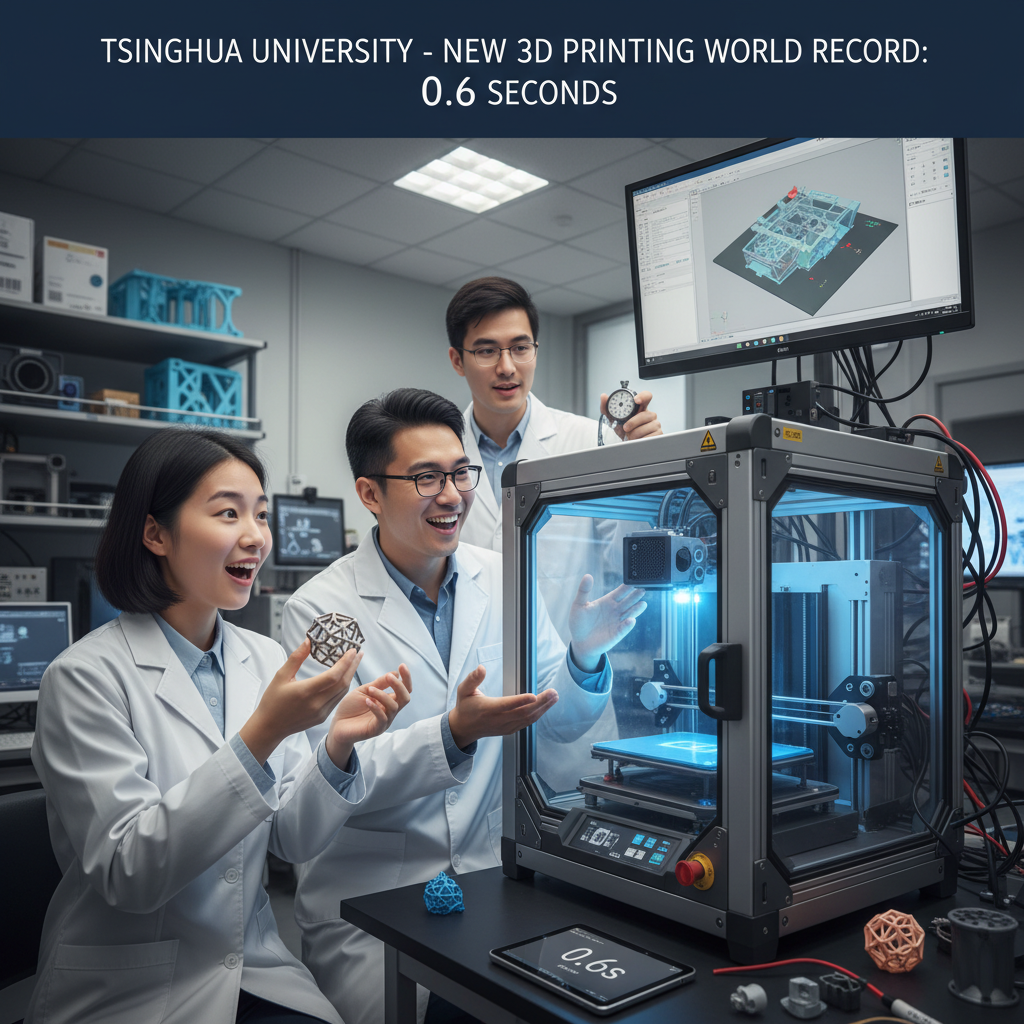
Chinese researchers at Tsinghua University have achieved a monumental feat in the realm of 3D printing, setting a new speed record with the development of ultra-fast technology. This groundbreaking innovation is capable of fabricating complex structures with millimeter precision in an astonishing just 0.6 seconds.
The core of this breakthrough lies in its sophisticated use of computational optics to control high-dimensional holographic light fields. This advanced method allows for the rapid and precise creation of intricate geometries, pushing the boundaries of what was previously thought possible in additive manufacturing.
The new technique can produce structures with exceptionally fine feature sizes, reaching down to as small as 12 micrometers. Furthermore, it boasts an incredible printing speed of up to 333 cubic millimeters per second, making it one of the fastest 3D printing methods ever developed.
This significant advance is the culmination of five years of dedicated research. The Tsinghua team focused intently on overcoming long-standing challenges associated with the high-speed modulation of light fields—a critical hurdle in accelerating 3D printing processes. This achievement not only pushes the boundaries of additive manufacturing but also opens new avenues for applications requiring rapid prototyping and on-demand production of highly detailed components.
Accelerate Your Projects: Leveraging Professional 3D Printing Services
While Tsinghua's breakthrough promises future advancements in high-speed manufacturing, many businesses, designers, and educators require reliable 3D printing solutions today. For those looking to bring their designs to life without investing in complex and expensive equipment, professional 3D printing services offer an invaluable resource.
PrintIn3D.ie, for example, specializes in high-quality PLA prints for prototypes and small production runs, with convenient shipping across Europe. Users can simply submit their CAD files, and the service handles all the complexities, including slicing, optimal orientation, and thorough quality checks. This ensures dependable, high-quality prints with transparent lead times, allowing product teams, designers, and educators to focus on innovation rather than the intricacies of additive manufacturing. It's an ideal solution for achieving success with diverse 3D printing needs efficiently and reliably, making professional-grade results accessible for a wide range of projects.
[1] Information sourced from provided prompt.