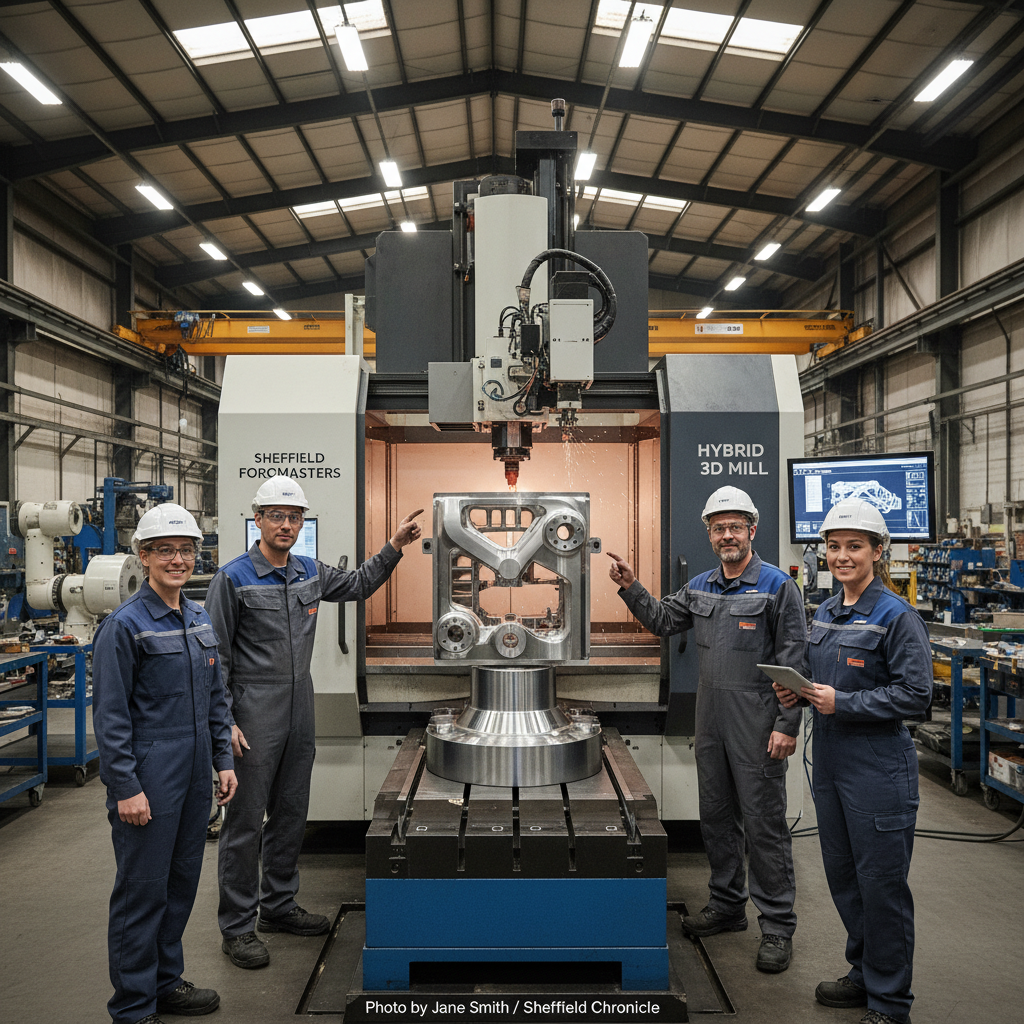
In a significant leap forward for manufacturing technology, UK-based Sheffield Forgemasters has officially launched a revolutionary large-scale hybrid system. This innovative setup seamlessly integrates additive 3D printing with subtractive milling, promising to redefine efficiency, flexibility, and speed in the realm of casting production.
A Closer Look at the Hybrid System
At the heart of this ground-breaking system is a CEAD Flexbot printer, housed within an impressive 14m x 8m x 5m enclosure. This colossal workspace allows for the creation of substantial components, pushing the boundaries of what's possible with industrial 3D printing. The true ingenuity lies in its robotic arms, which are capable of both depositing material layer by layer (additive manufacturing) and precisely removing material (subtractive milling). This dual capability addresses common challenges in large-scale additive manufacturing, such as achieving smooth finishes and tight tolerances, by allowing in-process machining.
Driving Efficiency and Autonomy
Senior development engineer Michael Howson highlighted the transformative potential of the new system, stating, "It enables autonomous operation, reduces costs, shortens lead times, and allows production outside standard hours."
This statement underscores the system's ability to operate with minimal human intervention, leading to significant reductions in operational costs and accelerated production cycles. The capacity for continuous operation, even beyond conventional working hours, means manufacturers can maximize output and meet demand more effectively, positioning Sheffield Forgemasters at the forefront of modern industrial innovation.
Impact on Casting Production
The integration of 3D printing and milling within a single system is particularly impactful for casting production. Traditionally, pattern making for casting can be time-consuming and costly. By leveraging this hybrid approach, Sheffield Forgemasters can rapidly produce complex patterns with high accuracy, drastically cutting down on lead times and offering unprecedented design flexibility. This not only streamlines the production process but also opens up possibilities for intricate designs and custom components that were previously challenging or uneconomical to produce.
[1] Information based on the provided launch details.