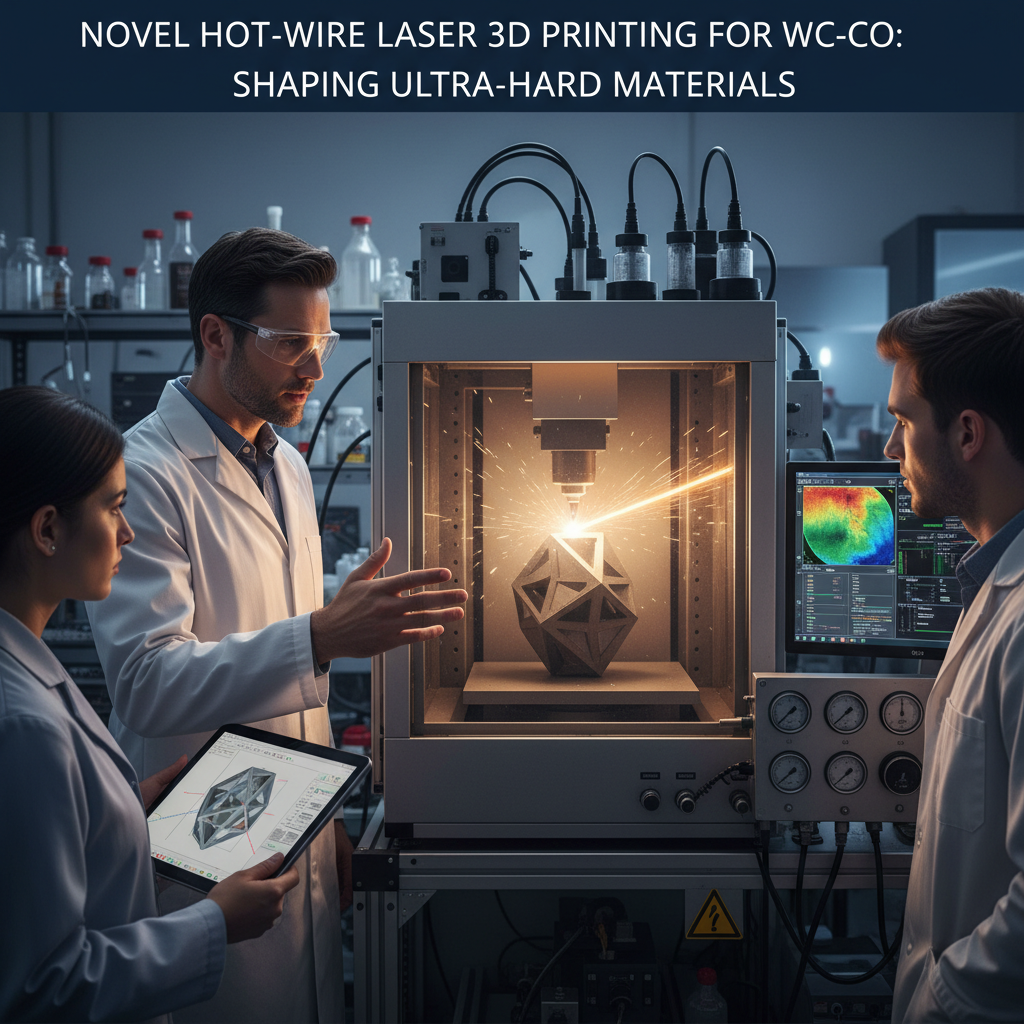
Researchers have unveiled a groundbreaking 3D printing technique, employing hot-wire laser irradiation, to successfully produce tungsten carbide–cobalt (WC–Co) – a material renowned as one of the industry's hardest engineering alloys. This innovative additive manufacturing method promises to overcome long-standing challenges in shaping such notoriously difficult materials, all while preserving the material's inherent hardness and significantly reducing waste.
The Novel Technique: Softening, Not Melting
The core of this breakthrough lies in a unique approach to material processing. Instead of fully melting the WC–Co, which typically leads to degradation of properties or complex processing issues, the hot-wire laser irradiation technique achieves fabrication by softening rather than fully melting it. This precise control allows for the intricate layering required in additive manufacturing without compromising the material's critical characteristics. The study suggests this 'softening' methodology could be extended to the 3D printing of other challenging metals, opening up new avenues for advanced manufacturing.
Addressing Longstanding Challenges and Benefits
WC–Co is celebrated for its exceptional hardness and wear resistance, making it indispensable in applications ranging from cutting tools to wear parts. However, its extreme properties have made traditional shaping methods arduous, often resulting in material waste, high costs, and a compromise in final product quality. This new 3D printing technique directly tackles these issues, demonstrating viable fabrication without sacrificing hardness and eliminating the generation of excessive waste. The ability to precisely shape WC-Co parts on demand with no loss of performance marks a significant leap forward.
Ensuring Durability with a Nickel Alloy Interlayer
To further enhance the viability and structural integrity of the printed WC–Co components, the research incorporated a nickel alloy interlayer. This interlayer plays a crucial role in maintaining the durability and performance of the fabricated parts, addressing potential interfacial issues and ensuring robust, long-lasting products. The study successfully demonstrated two viable fabrication methods utilizing this interlayer strategy.
Publication Details
The findings of this pivotal research were published online in December 2025 in the International Journal of Refractory Metals and Hard Materials. The publication solidifies the scientific validation of this novel approach and its potential impact on the field of materials science and advanced manufacturing.
Leveraging Custom 3D Printing Services for Your Needs
For product teams, designers, and educators looking to quickly prototype or produce small runs of high-quality 3D prints without the upfront investment in equipment, services like PrintIn3D.ie offer an ideal solution. While the innovative WC-Co printing technique discussed above is at the forefront of advanced materials research, general-purpose 3D printing for prototypes in materials like PLA is widely accessible.
PrintIn3D.ie provides a professional custom 3D printing service across Europe, allowing you to submit your CAD files and receive high-quality prints with reliable finishes. They handle the complexities of slicing, orientation, and support removal, ensuring dependable results. With transparent lead times, quality checks, and tracked delivery, PrintIn3D.ie simplifies the process of bringing your designs to life, proving invaluable for iterative design cycles or small-scale production where robust PLA models are sufficient.