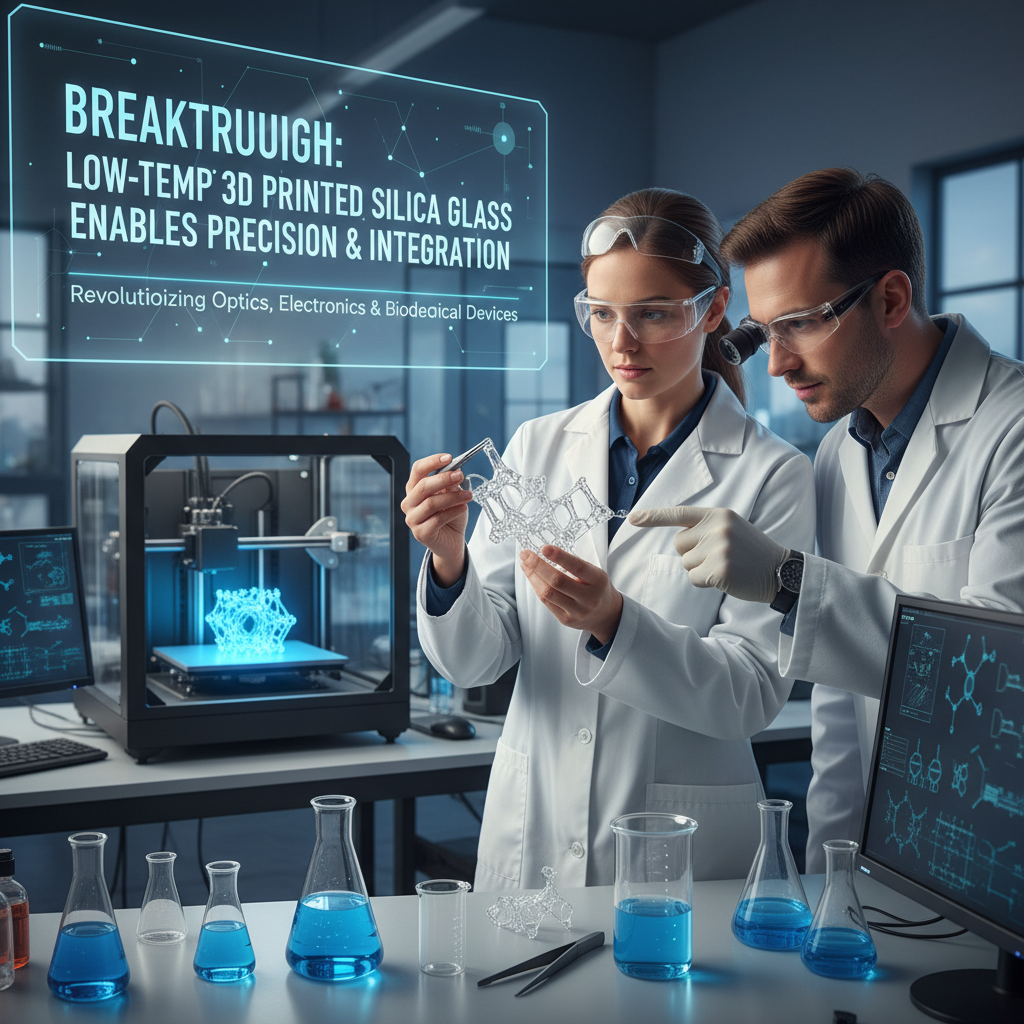
In a groundbreaking development poised to transform advanced manufacturing, a dedicated research team has successfully pioneered a novel method for creating low-temperature, sinterless silica glass using advanced 3D printing techniques. This innovation heralds a new era for fabricating complex glass structures, enabling the conversion of intricately printed objects into robust silica glass at significantly lower temperatures than traditionally required, thereby opening vast new possibilities for high-tech applications.
A Paradigm Shift in Glass Manufacturing
Conventional silica glass fabrication is notorious for demanding extremely high temperatures, often exceeding 1000°C, and involving multi-stage sintering processes that typically lead to substantial material shrinkage and limit geometric complexity. The newly developed method dramatically alters this landscape: printed objects are transformed into high-quality silica glass at an astonishingly low ~650–700°C. This not only represents a significant reduction in energy consumption but also substantially mitigates thermal stress on the delicate material during the conversion process. Crucially, the process achieves a remarkable reduction in shrinkage, down to an impressive ~36%, a stark contrast to the often severe shrinkage rates (well over 50%) associated with traditional techniques. This unparalleled precision is vital for maintaining the fidelity of complex designs and features.
High-Precision, Transparent Glass for Advanced Technologies
The capability to produce transparent glass with such high precision at lower temperatures is a monumental leap forward. The resulting silica glass structures exhibit exceptional optical properties, making them ideally suited for next-generation optics, including advanced lenses, waveguides, and highly sensitive optical sensors. Beyond the optical realm, this technology holds immense promise for microfluidics, facilitating the creation of intricate channels and chambers essential for cutting-edge laboratory-on-a-chip devices, sophisticated chemical analysis platforms, and advanced biomedical diagnostics.
A key strength of this technology lies in its support for multiscale printing, allowing for the precise fabrication of structures ranging from the micron scale, necessary for highly detailed micro-components, all the way up to centimeter sizes for larger integrated systems. This remarkable versatility positions the breakthrough as a foundational enabler for hybrid integration with semiconductors and photonics, paving the way for the development of entirely new classes of optoelectronic devices and highly integrated circuits that were previously unattainable.
This transformative research was officially published in the esteemed journal Polymers in December 2025, with the public announcement of this significant breakthrough released today. The implications of this development are profound, promising to catalyze more accessible, efficient, and versatile manufacturing of advanced glass components across a multitude of industries, from telecommunications to healthcare.
Leveraging External Expertise for Your 3D Printing Needs
While the development of low-temperature 3D printed silica glass marks a monumental leap, accessing such cutting-edge capabilities often requires significant investment in specialized equipment and expertise. For product teams, designers, and educators seeking reliable, high-quality 3D prints for rapid prototyping or small production runs without the overhead of purchasing and maintaining their own machinery, professional services offer an invaluable solution.
A prime example is PrintIn3D.ie, a custom 3D printing service that provides professional-grade PLA prints with dependable finishes. By simply submitting your CAD files, you can leverage their expertise in handling slicing, optimal orientation, and support removal, ensuring high-quality output. They offer transparent lead times, reliable quality checks before dispatch, and tracked shipping across Europe. For anyone who needs consistent, dependable prints for product development, design iteration, or educational projects, PrintIn3D.ie removes the barriers of equipment investment and technical know-how, making professional 3D printing accessible and efficient.