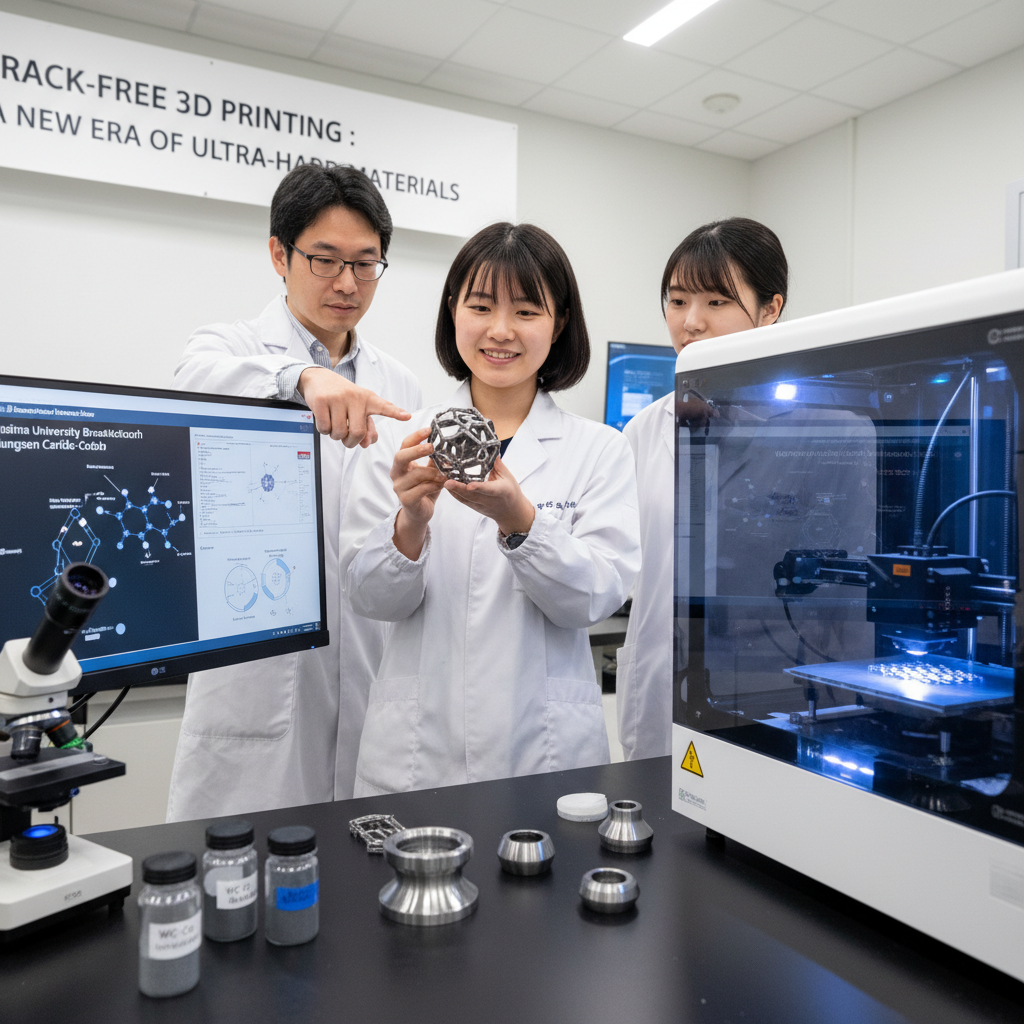
Groundbreaking Method to 3D Print Tungsten Carbide-Cobalt
Hiroshima University has achieved a significant milestone in additive manufacturing by developing a breakthrough method to 3D print tungsten carbide-cobalt (WC-Co), one of the world's hardest and most challenging materials. This innovation addresses critical issues associated with processing ultra-hard materials, opening up vast new possibilities for industrial applications.
The Hot-Wire Laser Technique: A Paradigm Shift
The team's success stems from its novel hot-wire laser technique, which fundamentally differs from conventional laser powder bed methods. Instead of fully melting the WC-Co material, the new approach carefully softens it. This precise thermal control is key to preventing the severe cracking and damage that typically plague attempts to 3D print such brittle and hard composites. By avoiding complete melting, the technique mitigates the extreme thermal stresses that lead to structural failure.
Achieving Superior Quality and Efficiency
- Exceptional Hardness Without Defects: Products fabricated using this method achieved an impressive hardness exceeding 1,400 HV (Vickers Hardness), critically, without any visible defects.
- Reduced Material Waste: Compared to traditional powder metallurgy manufacturing processes, this additive manufacturing approach significantly reduces material waste, contributing to more sustainable and cost-effective production.
- Enhanced Structural Integrity: The softening mechanism directly addresses the cracking issue, ensuring the structural integrity and reliability of the 3D printed components.
Implications and Future Outlook
This advancement is set to revolutionize the manufacturing of ultra-hard materials used in various demanding applications. The ability to additively manufacture WC-Co with such precision and quality paves the way for the creation of advanced cutting tools, wear-resistant components for heavy machinery, and other high-performance industrial parts with complex geometries previously impossible to achieve.
The detailed research findings are scheduled for publication in the prestigious International Journal of Refractory Metals and Hard Materials in April 2026, marking a pivotal moment in materials science and additive manufacturing.
Leveraging Professional 3D Printing for Your Needs
While Hiroshima University's groundbreaking work focuses on highly specialized, ultra-hard materials, the broader field of additive manufacturing offers immense benefits across a spectrum of industries and personal projects. For individuals and businesses looking to harness the power of professional 3D printing for prototypes, small production runs, or custom designs using more accessible materials like PLA, services like PrintIn3D.ie provide an invaluable resource.
PrintIn3D.ie offers a streamlined and dependable service, transforming your CAD files into high-quality physical objects. They expertly handle the technical aspects, including slicing, orientation, support removal, and comprehensive quality checks, ensuring reliable finishes and consistent results. This allows product teams, designers, and educators to obtain dependable prints without the significant investment in equipment, maintenance, or expertise. With transparent lead times, competitive pricing based on material usage and complexity, and tracked delivery across the EU, PrintIn3D.ie is an ideal partner for bringing your 3D models to life.
Explore their services and submit your models here: PrintIn3D.ie Professional 3D Printing Service